
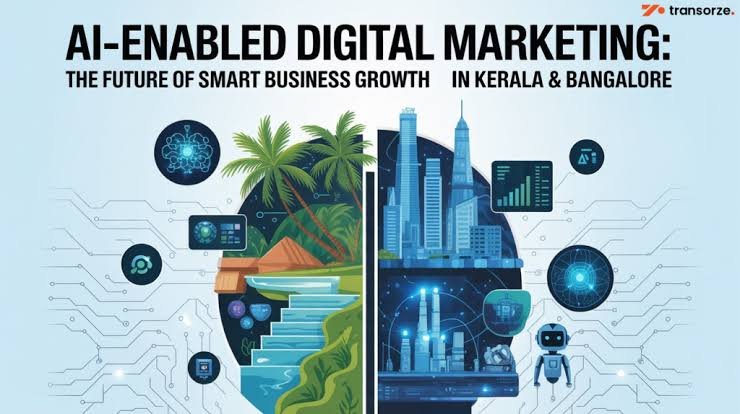
What Is AI-Powered Digital Marketing?
AI-powered digital marketing refers to the use of artificial intelligence, machine learning, predictive analytics, natural language processing, automation, and related technologies to plan, execute, personalize, and measure marketing activities. Instead of treating every visitor, prospect, or customer in exactly the same way, AI allows businesses to analyze large amounts of information and make more context-aware decisions. Think of traditional marketing as driving with a detailed map, while AI-powered marketing is more like having a smart navigation system that continuously studies traffic, predicts delays, and recommends a better route. The technology can support everything from audience segmentation and content creation to advertising optimization, customer service, lead scoring, and campaign analysis. This does not mean marketers suddenly become unnecessary; quite the opposite. The strongest approach combines machine efficiency with human creativity, judgment, empathy, and brand knowledge. Current industry research shows just how quickly this shift is happening. Salesforce reported in 2026 that 75% of marketers globally have adopted AI, while 85% say AI is reshaping their SEO strategy. The important question for businesses is therefore no longer simply whether AI should be explored, but where it can produce measurable value without sacrificing trust or quality.
How Artificial Intelligence Is Changing Marketing
Artificial intelligence is changing marketing by making decision-making faster, more predictive, and increasingly personalized. A marketing team can use AI to identify patterns that would take humans much longer to discover, such as which audiences are most likely to convert, which content topics attract qualified visitors, when customers are most responsive, or which advertising messages are losing effectiveness. Generative AI can also help marketers brainstorm campaigns, summarize research, develop content variations, analyze customer feedback, and accelerate repetitive production tasks. Predictive systems take this further by using historical and behavioral data to estimate what may happen next. The result is a marketing operation that can respond to changing customer behavior rather than relying entirely on assumptions made weeks or months earlier. Google is also changing the discovery environment itself: its 2026 Search updates increasingly integrate AI Overviews and AI Mode into a more conversational search experience, meaning users can ask follow-up questions and explore information without following the traditional sequence of individual searches. For businesses, that means digital marketing is evolving from simply publishing messages toward understanding intent, providing useful answers, and building experiences that remain valuable even when AI sits between the customer and the website.
Why AI Marketing Matters for Modern Businesses
The biggest reason AI-powered marketing matters is simple: customers expect relevance and speed. People have become accustomed to instant answers, personalized recommendations, conversational interfaces, and experiences that remember context. A generic advertisement shown to everyone may still generate impressions, but it has a much harder job competing with experiences that understand what someone actually wants. Salesforce’s 2026 research found that 86% of marketers say AI is raising customer expectations, while 83% say customers increasingly expect two-way conversations with brands. This creates a fascinating challenge for businesses. Customers want brands to understand them, but marketers cannot manually personalize every interaction across websites, email, social media, advertising, and customer service. AI helps bridge that gap by processing information at a scale humans cannot reasonably manage alone. For a small business, this could mean automating repetitive campaign analysis or creating personalized follow-ups; for a larger organization, it could mean coordinating millions of customer interactions. The goal is not to make marketing feel robotic. The goal is to make the underlying system intelligent enough that the customer experience can feel more relevant, timely, and human.
From Mass Marketing to Intelligent Personalization
Personalization used to mean putting a customer’s first name into an email subject line and calling it a day. AI-powered personalization is considerably more sophisticated. Modern systems can combine behavioral signals, purchase history, browsing patterns, engagement data, preferences, and contextual information to determine which message may be most appropriate for a particular customer segment. A retailer might promote different products based on browsing behavior, while a software company might adjust its messaging depending on whether someone is researching, comparing solutions, or preparing to buy. The real opportunity is not simply showing different people different advertisements; it is creating a journey that feels increasingly relevant at every stage. Yet there is a major lesson hidden inside the personalization race: better AI requires better data. Salesforce’s 2026 research found that marketers with unified customer data were substantially more likely to connect touchpoints and use AI agents effectively. Without reliable information, an intelligent system can still produce irrelevant recommendations at impressive speed. In other words, AI is not a magic wand that fixes poor marketing foundations. It is an amplifier. Give it clean, useful data and strong strategy, and it can amplify performance; give it fragmented information and unclear goals, and it can amplify confusion.
AI and Customer Data
Data is the fuel behind AI-powered digital marketing, but simply collecting more data does not automatically create better marketing. Businesses need to understand what information they have, where it comes from, whether it is accurate, and how it can legitimately be used. Customer relationship management systems, website analytics, advertising platforms, email systems, ecommerce platforms, and support tools can all contain valuable pieces of the customer journey. AI becomes particularly useful when these pieces can be interpreted together rather than sitting in isolated systems. Consider a customer who visits a product page three times, downloads a guide, opens two emails, and then speaks with a support representative. Looking at each action independently tells only part of the story. Connecting those signals can provide a much clearer picture of intent. The challenge is that many organizations still struggle with disconnected information. Salesforce reported that only 58% of marketers have complete access to service data, 56% to sales data, and 51% to commerce data. This explains why data strategy must sit at the center of AI marketing. Businesses should focus less on collecting everything and more on creating trustworthy, relevant customer information that marketing systems can actually use.
Predictive Analytics and Customer Intent
Predictive analytics allows marketers to move from asking, “What happened?” toward asking, “What is likely to happen next?” AI models can examine patterns across historical campaigns, customer behavior, transactions, and engagement signals to estimate outcomes such as purchase probability, churn risk, or lead quality. Imagine having thousands of prospects in a sales funnel. Instead of treating all of them equally, predictive models can help identify which prospects show stronger signals of potential conversion. Marketing teams can then prioritize their resources accordingly. This does not mean a prediction is guaranteed to be correct; AI is working with probabilities, not crystal balls. Good marketers therefore use predictive analytics as decision support rather than unquestionable truth. When combined with human review, these systems can improve resource allocation and help teams concentrate their attention where it is most likely to matter. The same principle applies to customer retention. If certain behavioral patterns historically appear before customers disengage, AI can help identify similar situations earlier. Businesses can then respond with useful content, support, education, or offers where appropriate. That transforms marketing from a largely reactive discipline into a more proactive one.
AI-Powered Content Marketing
Content marketing has perhaps experienced one of the most visible AI transformations. Generative AI can help marketers research subjects, develop outlines, brainstorm headlines, summarize information, generate content variations, and adapt existing material for different channels. That speed can be extremely valuable when a business needs to maintain a consistent publishing schedule. However, producing more content is not the same thing as producing better content. If every company uses AI to generate the same generic articles based on the same surface-level information, the internet simply becomes noisier. The competitive advantage therefore moves toward original insight, expertise, useful data, strong storytelling, and authentic brand perspective. AI should be treated like a capable creative assistant rather than an autopilot. A marketer can use it to accelerate repetitive parts of the process while still providing the judgment that makes the final work distinctive. This approach also protects the human qualities that audiences value: experience, humor, context, empathy, and a clear point of view. The future of content marketing is unlikely to be humans versus AI. It is more likely to be marketers who know how to combine human originality with machine-assisted efficiency outperforming marketers who rely entirely on either one.
Faster Content Creation Without Losing the Human Voice
Speed is one of AI’s biggest advantages, particularly for businesses operating with small marketing teams. A single marketer can use AI-assisted workflows to turn research into a content brief, transform a long article into social posts, identify frequently asked questions, generate email variations, and organize campaign ideas. But the human voice still matters because customers do not build relationships with algorithms; they build relationships with brands and the people behind them. Before publishing AI-assisted content, marketers should check facts, refine the tone, remove generic language, add firsthand expertise, and ensure that every claim can be supported. This becomes even more important in industries where accuracy and trust directly affect customer decisions. A useful principle is simple: let AI increase the speed of your thinking, not replace your responsibility for what gets published. When AI handles repetitive work, marketers gain more time for strategy, interviews, research, creative direction, and customer understanding. Salesforce found that 88% of marketers using AI say it helps them do their jobs better, illustrating why adoption is increasingly connected to productivity rather than merely experimentation. The smartest content teams will therefore focus on creating a workflow in which technology handles scale while humans protect originality and credibility.
AI in SEO and Search Visibility
Search engine optimization is entering a major transition because users are increasingly receiving synthesized answers directly within search experiences. Google has expanded AI Overviews and AI Mode, making search more conversational and allowing users to continue exploring a topic through follow-up questions. For marketers, this means visibility is no longer limited to achieving a traditional blue-link ranking. Brands increasingly need content that can be understood, trusted, referenced, and surfaced within AI-generated answers. This has contributed to growing interest in Answer Engine Optimization, often abbreviated as AEO. Instead of focusing exclusively on individual keywords, marketers need to think about questions, entities, context, user intent, structured information, original research, and the credibility of their sources. Salesforce reported that 88% of global marketers had already begun optimizing for AI-generated responses, while high-performing marketers were more likely to optimize for AI search. The fundamentals of SEO have not disappeared, though. Technical accessibility, useful content, strong information architecture, relevant internal linking, and genuine authority still matter. AI search simply adds another layer to the visibility equation.
The Rise of AI Search and Answer Engine Optimization
Answer Engine Optimization focuses on making information useful and understandable for systems that generate direct answers. Imagine that a customer asks an AI search system, “What is the best type of digital marketing strategy for a growing local business?” The system may synthesize information from multiple sources rather than simply displaying ten pages of results. A brand that wants to appear in that environment needs more than keyword repetition. It needs genuinely useful information that demonstrates expertise and answers real questions clearly. This creates an interesting opportunity for businesses willing to publish original research, practical guides, expert commentary, case studies, and detailed explanations. At the same time, marketers should avoid chasing every new AI-search trend as if it were a shortcut. Search systems continue to evolve, and no legitimate strategy can guarantee that a particular page will always be selected. The durable approach is to create information that deserves to be discovered. Google’s 2026 updates emphasize helping users discover relevant websites and original content within AI-powered search experiences. That reinforces a broader lesson: the future of SEO is not about manipulating AI systems; it is about becoming a useful, credible source that AI systems and humans have good reason to trust.
AI-Powered Social Media Marketing
Social media marketing generates enormous amounts of information every day, from comments and reactions to watch time, shares, saves, clicks, and purchasing behavior. AI can analyze these signals much faster than a human team and help marketers understand what types of content resonate with different audiences. It can assist with content ideation, sentiment analysis, audience segmentation, scheduling, performance reporting, and creative testing. AI can also help brands adapt a core campaign concept into multiple formats without starting from scratch each time. However, social media remains deeply human. A perfectly optimized post can still fail if it sounds artificial, insensitive, or disconnected from the community. Businesses should therefore use AI to identify patterns while allowing humans to make the final decisions about culture, humor, sensitive subjects, and brand personality. This is especially important because social audiences react quickly when they feel a company is speaking at them instead of listening to them. AI can help a business hear thousands of conversations at once, but the response still needs judgment. The best social strategy combines machine-assisted listening with human-led storytelling, creating a feedback loop where audience behavior informs future content without turning the brand into a content machine.
Smarter Paid Advertising With AI
Paid advertising is another area where AI can dramatically improve efficiency because advertising platforms already generate vast quantities of performance data. AI systems can evaluate audience signals, creative variations, conversion patterns, bidding conditions, and campaign performance to help allocate advertising resources. Instead of manually testing every possible combination, marketers can use automation to explore multiple variations and identify stronger-performing patterns. The value becomes particularly obvious when a campaign contains thousands of possible combinations of audiences, messages, placements, and creative assets. Humans can establish the strategy and guardrails while algorithms handle repetitive optimization. Yet automation does not eliminate the need for marketing expertise. If the underlying offer is weak, the audience is misunderstood, or the campaign objective is poorly defined, AI may simply optimize a bad strategy faster. Successful AI advertising therefore starts with fundamentals: clear positioning, a compelling offer, reliable conversion tracking, strong creative, and meaningful business objectives. AI then becomes an optimization layer rather than a substitute for strategy. For small businesses, this can reduce the workload associated with monitoring campaigns; for larger brands, it can make experimentation and optimization possible at a much greater scale.
AI Chatbots and Conversational Marketing
AI-powered chatbots have evolved beyond simple scripted menus. Modern conversational systems can understand natural-language questions, maintain context, retrieve information, and help customers navigate products or services. This creates a major opportunity for businesses because customers increasingly expect immediate responses. Salesforce found that 83% of marketers globally say customers now expect two-way conversations with brands, while 69% report difficulty responding promptly. An AI assistant can help close that gap by handling common questions at any hour and escalating more complicated situations to human employees. For example, a customer might ask about product compatibility, delivery information, service options, or account procedures and receive an immediate response. The goal should not be to hide humans behind automation. Instead, AI should handle appropriate routine interactions while making it easy for customers to reach a person when the situation requires empathy, judgment, or specialized assistance.
Building Two-Way Customer Experiences
Two-way marketing represents a deeper change than simply adding a chatbot to a website. It means designing marketing around conversation rather than broadcasting. A customer might respond to an email, ask a question through a social channel, interact with an AI assistant, or request additional information after seeing an advertisement. Businesses need systems that can understand these interactions as connected parts of one customer journey. AI can help by interpreting messages, identifying intent, recommending next steps, and routing conversations appropriately. This is where unified customer data becomes crucial. If the chatbot knows nothing about the customer’s previous interaction, it may ask repetitive questions and create exactly the frustrating experience automation was supposed to eliminate. In India, Salesforce reported in 2026 that 81% of marketers had adopted AI, while 92% said customers increasingly expect two-way conversations. These numbers demonstrate how quickly expectations are changing. The winning brands will not simply automate replies; they will design connected experiences where customers can move naturally between marketing, sales, service, and human support.
AI Email Marketing and Lead Nurturing
Email marketing becomes significantly more powerful when AI is used to understand timing, behavior, content preferences, and customer intent. Instead of sending the same message to an entire mailing list, marketers can create more relevant sequences based on where customers are in their journey. Someone who has just downloaded an introductory guide may need educational content, while someone who has repeatedly viewed a pricing page may be looking for comparisons, proof, or a direct conversation. AI can help identify these patterns and recommend appropriate next actions. It can also assist with subject-line experimentation, content variations, segmentation, send-time optimization, and campaign analysis. However, personalization must remain useful rather than creepy. Customers should feel that a company understands their needs, not that it is watching every movement they make. A thoughtful email strategy therefore combines behavioral intelligence with sensible boundaries. The objective is to deliver the right information at the right stage, not simply to maximize the number of automated messages. When done properly, AI-powered email marketing can help businesses nurture relationships over time and turn a database of contacts into a more meaningful customer community.
Predictive Lead Scoring and Sales Alignment
One of the biggest problems between marketing and sales is disagreement over what qualifies as a valuable lead. AI-powered lead scoring can help create a more data-informed definition by examining behavioral and historical signals associated with successful conversions. Instead of relying solely on a demographic profile, a scoring system might consider engagement, content interactions, product interest, website behavior, and other legitimate business signals. Sales teams can then prioritize leads showing stronger signs of readiness. Marketing teams benefit because they can better understand which campaigns generate valuable opportunities rather than merely large quantities of leads. This creates a shared feedback loop. Sales outcomes inform marketing models, marketing insights improve targeting, and customer behavior continuously refines the system. AI can also help identify patterns that humans might overlook, but businesses should regularly review scoring models because customer behavior changes. A model trained on yesterday’s market can become less useful when products, competitors, economic conditions, or customer expectations shift. The best lead-scoring systems are therefore not set-and-forget tools; they are evolving decision-support systems connected to real business outcomes.
AI Marketing Automation
Marketing automation traditionally handled repetitive workflows such as email sequences, lead notifications, campaign scheduling, and basic segmentation. AI pushes automation toward more adaptive decision-making. Instead of simply following a fixed “if this, then that” rule, AI-assisted systems can interpret information and determine which action is most appropriate within defined boundaries. This could involve adjusting a campaign audience, recommending content, identifying a customer likely to need assistance, or summarizing campaign performance for a marketing manager. The concept of agentic marketing is particularly important here, because AI systems are increasingly being designed to perform multi-step tasks rather than only generate individual pieces of content. Salesforce’s 2026 research highlights this movement toward AI agents and connected customer experiences. Businesses should still introduce automation carefully. Every automated action should have a clear objective, measurable success criteria, appropriate permissions, and human oversight where necessary. Automation should remove friction, not remove accountability. When those principles are followed, AI can turn marketing operations from a collection of disconnected tasks into a coordinated system that learns from results and continuously improves execution.
Benefits of AI-Powered Digital Marketing
The benefits of AI-powered digital marketing extend across productivity, personalization, analytics, customer engagement, and scalability. AI can process large datasets quickly, automate repetitive work, identify patterns, generate content variations, support customer conversations, and help marketers make decisions using real-time or historical signals. This can be particularly valuable for small businesses that cannot afford large specialist teams. Instead of hiring separate people for every repetitive marketing function, a smaller team can use AI-assisted systems to multiply its capacity while retaining human control over strategy and brand direction. Larger organizations can use the same principle at a different scale, coordinating complex campaigns across multiple regions, products, and customer segments. AI also makes experimentation more practical because marketers can analyze multiple variations faster. Yet perhaps the most important benefit is not speed. It is better allocation of human attention. When machines handle repetitive analysis and production, marketers can spend more time talking to customers, developing ideas, solving positioning problems, and making strategic decisions. That is where technology becomes genuinely valuable: not when it replaces thinking, but when it gives people more room to think.
Challenges and Risks of AI Marketing
AI marketing also brings meaningful challenges. The first is the temptation to prioritize quantity over quality. If generating content becomes effortless, businesses may publish too much low-value material and weaken their brand rather than strengthen it. The second challenge is inaccurate or misleading AI output. Generative systems can produce confident-sounding information that requires human verification, making editorial oversight essential. A third issue is customer trust. People may appreciate personalization until they feel that a company is using information in ways they did not expect. There are also concerns around biased algorithms, poor data, security, intellectual property, and excessive dependence on third-party platforms. Another challenge is organizational rather than technical: employees need to know how to use AI effectively. Recent research indicates that many businesses are moving beyond experimentation but still face integration and capability gaps. The solution is not to reject AI. It is to establish clear rules about where AI is appropriate, what requires human approval, how data is handled, and how performance will be evaluated. Responsible adoption creates a stronger foundation than blindly automating everything possible.
Privacy, Data Quality, and Responsible AI
Responsible AI marketing starts with respecting the customer. Businesses should collect information for legitimate purposes, protect it appropriately, communicate clearly about relevant data practices, and avoid using personalization simply because a technology makes it possible. Data quality matters just as much as data quantity. If customer records contain duplicates, outdated information, missing context, or contradictory signals, an AI system may produce poor recommendations. This is why data governance should be treated as part of marketing strategy rather than a purely technical concern. Organizations should also establish human review for important decisions, particularly when automated systems could materially affect customers. Transparency becomes increasingly valuable as consumers interact with AI-generated experiences. A trustworthy brand should be able to explain, at an appropriate level, how automation is being used and provide human assistance when necessary. AI should make the customer experience smoother, not make the customer feel powerless. Ultimately, the most successful companies will treat trust as a competitive advantage. Technology can copy a feature, automate a process, or generate content, but trust takes time to build and can disappear quickly when customers feel manipulated.
How Small Businesses Can Adopt AI Marketing
Small businesses do not need a giant technology budget to begin using AI. The smartest starting point is usually one repetitive problem that consumes time and has a measurable outcome. A local business might begin with customer inquiry automation, while an ecommerce company might focus on product-content workflows or customer segmentation. A service business could use AI to summarize customer feedback and identify recurring questions. The key is to avoid buying a complicated collection of tools simply because AI is fashionable. Start with the business problem, identify the workflow, determine what data is available, and then select the simplest technology capable of solving it. Once the first workflow produces measurable value, the business can expand gradually. A useful implementation cycle is identify, test, measure, improve, and scale. This keeps AI connected to actual business results rather than vanity metrics. The opportunity is particularly significant for India’s small and medium-sized businesses. Recent reporting on an Amazon Ads-commissioned study indicates that AI is helping Indian SMBs overcome traditional advertising constraints and reach new audiences and formats. AI can therefore become a practical equalizer, helping smaller teams compete through smarter execution rather than simply larger budgets.
Building an AI-Ready Marketing Strategy
An AI-ready marketing strategy begins with fundamentals: a clear target audience, strong positioning, measurable objectives, reliable data, and a well-defined customer journey. Once those foundations are in place, businesses can identify where AI provides the greatest leverage. The next step is to map repetitive tasks and high-volume decisions across content, advertising, SEO, sales, customer service, and analytics. Some processes may be suitable for complete automation, while others should remain human-led with AI assistance. Businesses should also establish clear performance indicators before implementing a system. If the goal is lead generation, measure qualified leads and revenue rather than simply content output. If the goal is customer service, measure response time and satisfaction rather than chatbot conversations alone. If the goal is SEO, look beyond rankings and examine qualified traffic, conversions, visibility in AI search experiences, and brand discovery. A successful AI strategy is therefore less about having the most sophisticated technology and more about connecting technology to business outcomes. The companies that win will be those that treat AI as part of their operating model rather than as a collection of disconnected experiments.
Measuring AI Marketing ROI
AI marketing should ultimately answer one uncomfortable but necessary question: Is this actually helping the business grow? Measuring ROI requires comparing meaningful business outcomes before and after implementation. Depending on the use case, relevant metrics might include customer acquisition cost, conversion rate, qualified leads, revenue per customer, retention, response time, campaign efficiency, content production time, or return on advertising spend. Productivity metrics can also matter when automation reduces hours spent on repetitive tasks and allows employees to focus on higher-value work. However, businesses should avoid assuming that every improvement comes directly from AI. Marketing performance is influenced by pricing, market conditions, creative quality, competition, seasonality, product changes, and many other variables. Good measurement therefore requires clear experiments and reasonable comparison periods. AI should be evaluated like any other business investment. If a system saves 30 hours a month but creates no improvement in quality, revenue, or strategic capacity, its value may be limited. If it saves those hours while improving customer response and conversion, the business has a stronger case for scaling it.
The Future of AI-Powered Digital Marketing
The future of AI-powered digital marketing will likely be more conversational, predictive, automated, and deeply integrated into the customer journey. Search is already becoming more interactive, with Google reporting that AI Mode had surpassed 1 billion monthly active users by its 2026 I/O announcements, while AI Overviews had surpassed 2.5 billion monthly active users. Those numbers illustrate how quickly AI-mediated discovery is becoming part of mainstream digital behavior. Marketing will increasingly need to account for customers who ask AI systems for recommendations before visiting a company’s website. At the same time, agentic systems may take on more multi-step marketing and sales tasks, from analyzing campaign performance to coordinating personalized customer interactions. This does not make human marketers obsolete. It changes what makes a marketer valuable. Strategic thinking, creativity, customer empathy, ethical judgment, brand building, and the ability to ask the right questions become even more important when machines can execute tasks at extraordinary speed. The future belongs neither entirely to humans nor entirely to algorithms. It belongs to organizations that know how to combine both intelligently.
Conclusion
AI-powered digital marketing is becoming a core component of smarter business growth. It can help companies understand customers, personalize experiences, automate repetitive work, improve advertising, strengthen SEO, accelerate content production, and make decisions using patterns hidden inside large datasets. But the technology itself is not the strategy. Businesses still need a compelling product, a clear audience, trustworthy data, useful content, strong positioning, and people capable of making thoughtful decisions. Current research makes the direction unmistakable: AI adoption among marketers is already widespread, AI is reshaping SEO, and customer expectations are moving toward faster, more personalized, two-way interactions. The smartest approach is therefore not to chase every new AI feature. It is to identify where intelligence and automation can solve real customer and business problems, introduce the technology responsibly, measure the results, and continuously improve. When AI becomes a partner in better decision-making rather than a shortcut around good marketing, it can become one of the most powerful growth engines available to modern businesses.
Frequently Asked Questions
1. What is AI-powered digital marketing?
AI-powered digital marketing is the use of artificial intelligence technologies to improve marketing activities such as customer segmentation, content creation, SEO, advertising, personalization, analytics, automation, and customer communication. It allows businesses to process information faster and make more informed decisions while automating repetitive tasks.
2. How can AI improve digital marketing?
AI can improve digital marketing by identifying customer behavior patterns, personalizing campaigns, analyzing performance, supporting content production, optimizing advertising, predicting potential customer actions, and responding to common customer questions. The biggest advantage is the ability to perform these activities at a scale that would be difficult for a human team to manage manually.
3. Will AI replace digital marketers?
AI is more likely to change digital marketing jobs than eliminate the need for marketers altogether. Human skills such as creativity, strategic thinking, communication, brand positioning, ethical judgment, and customer understanding remain extremely important. Marketers who learn how to work effectively with AI can use it to reduce repetitive work and spend more time on higher-value decisions.
4. Is AI useful for small businesses?
Yes. Small businesses can use AI for practical tasks such as content planning, customer support, email personalization, advertising analysis, lead qualification, social media workflows, and reporting. The best approach is to begin with one specific business problem and measure whether AI produces a meaningful improvement before expanding its use.
5. How will AI change SEO?
AI is changing SEO because people increasingly discover information through AI-assisted search experiences as well as traditional search results. Businesses therefore need to create useful, trustworthy, well-structured content that can answer real questions and demonstrate expertise. SEO increasingly involves optimizing for both traditional search visibility and AI-generated discovery AI-powered marketing.